How Can Period Swimwear Make Period Swimming Easier?
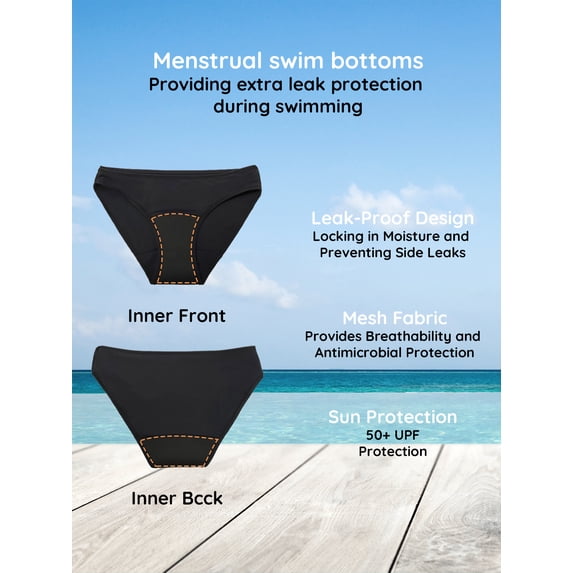
period swimwear can make swimming during menstruation easier by combining a normal swimsuit with an absorbent, leak-resistant gusset. NHS guidance says a typical period lasts 2–7 days and involves about 20–90 mL of blood loss, so protection needs vary widely between users. Unlike disposable pads, which take in surrounding water, swim-specific menstrual layers are designed to manage menstrual fluid while limiting water retention. For light-flow days, spotting, or backup with a tampon or menstrual cup, the garment can reduce changing-room visits and provide protection before swimming, in the water, and after leaving it.
A period does not become medically incompatible with swimming. The practical issue is managing menstrual fluid while the body moves through water and while the swimsuit repeatedly becomes wet and dries. NHS data place common menstrual blood loss at 20–90 mL over an entire period, usually spread across about 5 days rather than released at one time. Bleeding is often heaviest during the first 2 days, so the same swimsuit may perform very differently on day 1 and day 5.
That difference in daily flow explains why swimwear absorbency should not be treated as one fixed standard. A person losing 25 mL across a cycle has a different requirement from someone approaching 80 or 90 mL, and menstrual fluid is not distributed evenly by hour. A garment that works comfortably for 60 minutes on a light day may need extra protection during several hours at a beach or water park.
Water pressure can temporarily reduce the visible release of menstrual fluid while someone is submerged, but menstruation has not ended. Protection remains useful when standing up, walking out of the pool, sitting on a towel, or waiting for a changing room.
The transition out of the water is therefore as important as the swim itself. An ordinary swimsuit has almost no structure intended to hold menstrual fluid once gravity and normal movement resume. Period swimwear adds an absorbent zone close to the body, usually backed by a leak-resistant layer, so small amounts of fluid can be contained before they reach the outer fabric.
The construction is different from putting an ordinary sanitary pad inside a bikini bottom. Pads are made to absorb liquid rapidly, including water that enters from outside. A pad immersed for 20 or 30 minutes can take in pool water, become heavier, swell, and provide less useful capacity for menstrual fluid. Swim-specific garments try to keep the absorbent section thin and reduce unnecessary water retention.
A typical construction may combine several functions:
-
A skin-facing fabric moves fluid away from the surface.
-
An absorbent layer holds menstrual fluid within the gusset.
-
A leak-resistant membrane reduces movement of fluid toward the outer fabric.
-
Stretch swim fabric keeps the protective area close to the body during kicking and turning.
-
Elastic leg openings reduce gaps when the wearer sits, dives, or climbs out of a pool.
Thickness alone does not tell buyers how well that system works. Adding more absorbent material could increase dry-land capacity while also allowing the garment to retain more pool water. Swimwear designers therefore have to balance absorbency, drying time, stretch, weight, and coverage. Many modern swimsuits also use synthetic stretch fibers because a garment may extend repeatedly by well above 20% during normal swimming movements.
Absorbency claims deserve particular attention because there is no single universal labeling scale for menstrual swimwear. Tampons provide a useful comparison: current FDA labeling defines Light as 6 g or less, Regular as 6–9 g, Super as 9–12 g, Super Plus as 12–15 g, and Ultra as 15–18 g of standardized absorbency. A swimsuit advertised as “two tampons” is therefore incomplete information unless the manufacturer explains which tampon absorbency it uses for comparison.
| Published comparison | Standardized absorbency |
|---|---|
| Light tampon | ≤6 g |
| Regular tampon | 6–9 g |
| Super tampon | 9–12 g |
| Super Plus tampon | 12–15 g |
| Ultra tampon | 15–18 g |
The table also shows why shoppers should prefer a stated capacity in milliliters or grams over vague labels such as “high absorbency.” A claimed 10 mL capacity and a claimed 20 mL capacity are not equivalent, even if both products are marketed for medium flow. Product testing methods can differ as well, so capacity figures should be read as manufacturer-specific rather than a guarantee of identical real-world performance.
Flow level also affects whether period swimwear works best alone or with another product. On spotting and lighter days, some users may only need the built-in gusset. During heavier days, a tampon or menstrual cup can handle most menstrual fluid while the swimsuit catches smaller leaks. FDA guidance has recommended using the lowest tampon absorbency needed to control menstrual flow, rather than automatically choosing a higher rating.
Age creates another practical reason for offering an external swimming option. ACOG reports a median age of 12.43 years for the first period, and 98% of girls have started menstruating by age 15. During the first gynecologic year, the average cycle interval is about 32.2 days, while 90% of adolescent cycles fall between 21 and 45 days. Timing can therefore be less predictable for teenagers than for many adults.
For a teenager attending a weekly 45-minute swimming lesson, period swimwear can be worn when a period is expected but has not yet started. If spotting begins during school or shortly before the lesson, the wearer already has an absorbent layer in place. That can be more practical than learning to insert a tampon immediately before a scheduled activity.
Fit becomes more important once the garment is moving through water. The gusset needs to remain close to the body while the hips flex and the legs separate. A loose leg opening can allow the garment to shift, while an excessively tight opening can cause rubbing. A dry fitting check can include several squats, raised knees, a forward bend, and 20–30 seconds of simulated kicking.
Good fit should feel similar to secure athletic swimwear: close enough to stay in position, but not so tight that the gusset folds, the waistband rolls, or the leg openings leave persistent pressure marks.
Coverage also matters. Two products can advertise the same absorbency while using very different gusset lengths. A longer absorbent area can help with fluid movement when someone changes position between standing, sitting, swimming horizontally, and lying on a beach towel. Buyers should therefore examine both capacity and the physical dimensions of the protected area.
Time outside the pool deserves equal attention. Someone may swim for 40 minutes but remain in the same suit for another 2 hours while eating, walking, sunbathing, or traveling back to a hotel. Menstrual protection continues to be used during that period. A spare pair can be useful on longer outings, especially when the first garment remains damp.
Reusable use changes the cost calculation as well. If one swimsuit is worn 30 times over two swimming seasons, the purchase cost is spread over 30 uses rather than one. It can also replace some disposable products on lighter-flow swimming days, although the actual number depends on flow, washing habits, garment lifespan, and whether a tampon is still used as backup.
Washing affects that lifespan. Chlorine, salt, body oils, sunscreen, heat, and repeated stretching gradually wear swim fabrics. Rinsing soon after use removes menstrual residue and reduces the amount of pool chemicals left in the textile. Care instructions vary by brand, but high dryer temperatures and fabric softeners are commonly worth avoiding when the manufacturer says they may affect stretch fabrics or functional layers.
Health-related flow patterns should not be ignored when choosing protection. ACOG describes periods lasting more than 7 days or requiring product changes every 1–2 hours as signs that bleeding may be excessive. Around 20% of adolescents evaluated for heavy menstrual bleeding have an underlying bleeding disorder, rising to about 33% among adolescents hospitalized for heavy menstrual bleeding. Swimwear capacity is not a substitute for medical assessment when bleeding reaches that level.
For everyday purchasing, four measurable details are more useful than broad marketing language: stated absorbency, gusset dimensions, size measurements, and care limits. Someone with a 72 cm waist should compare that measurement with the brand's size chart instead of assuming that a familiar letter size will fit identically across manufacturers.
A practical choice can therefore look like this:
-
Light spotting: period swimwear alone may provide enough capacity.
-
Moderate flow: check the stated mL or gram rating and planned wear time.
-
Heavier flow: consider pairing the swimsuit with a tampon or menstrual cup.
-
More than 7 days of bleeding or changes every 1–2 hours: speak with a healthcare professional rather than relying on higher-capacity garments alone.
-
Long beach days: carry a dry replacement rather than staying in one wet garment for many hours.
Period swimwear works best when its job is defined narrowly: manage a limited amount of menstrual fluid while still functioning as swimwear. It does not need to hold an entire 20–90 mL menstrual cycle in one wearing, and it should not be judged by that standard. Matching measurable absorbency, secure fit, adequate gusset coverage, flow level, and planned wear time gives the wearer a more realistic way to swim during a period without treating every pool visit as a special event.