Shaker Cabinets Online: Shipping and Claims
A cabinet order is a freight transaction before it is a kitchen, and the two moments that decide whether it goes well are the $2,500 free-shipping line and the five minutes spent inspecting cartons at the tailgate. CasaBuilt publishes 3-10 business days for RTA orders, with Alaska and Hawaii excluded, and free shipping on orders of $2,500 or more. Everything else in this article is about the gap between those two facts.

Key takeaways
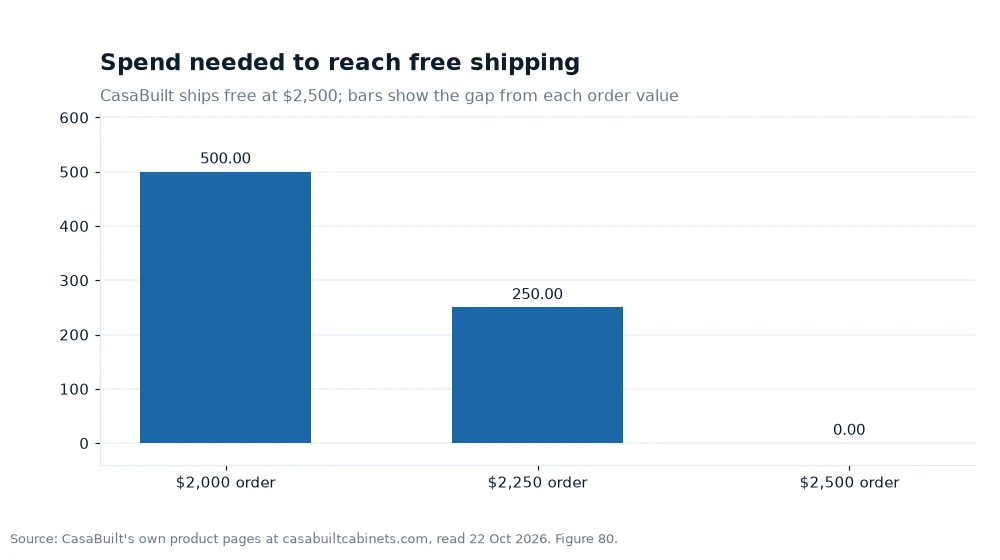
- Free shipping begins at $2,500, so the gap from a $2,000 order is $500.
- RTA cabinets ship in 3-10 business days; pre-assembled cabinets are quoted at within two weeks.
- Alaska and Hawaii are excluded from the standard RTA shipping window.
- The warranty is one year against manufacturing defects, which is a different matter from freight damage.
Freight is the line item buyers forget to price
Cabinet shopping conversations are about doors, boxes and finishes, and then the order total arrives with a freight line that nobody planned for. That is not a trick; it is how heavy goods move. A flat-pack cabinet is dense, the cartons are long, and a residential delivery involves a liftgate and often a single driver with a pallet jack and no help.
The practical response is to plan the order value before the order, not after. If the kitchen list lands at $2,300, the buyer has a decision: pay freight on $2,300, or add $200 of product that was going to be bought eventually and cross the free-shipping line. Neither answer is automatically right, but the decision should be made deliberately, with the number known.
It also helps to know what arrives. Flat-pack boxes contain panels, hardware and instructions, and the parts need to be stored until installation. A garage bay or a dry spare room is the right holding area. Cartons stacked on a damp concrete floor for three weeks are how a flat panel acquires a warp before it is ever assembled.
What the published windows actually say
CasaBuilt publishes several shipping terms for different routes, and they are easy to conflate. Read separately, each one describes a specific product and a specific clock, and the clock starts when the order ships rather than when it is placed.
| Term | Published detail | What it applies to |
|---|---|---|
| RTA lead time | 3-10 business days | Flat-pack cabinets; collection page also states 7-10 business days |
| Pre-assembled lead time | Within 2 weeks | Assembled cabinets |
| Trade quick ship | 3 business days or less | Eligible trade program orders |
| Free shipping | Orders of $2,500 or more | Standard RTA shipping |
| Excluded regions | Alaska and Hawaii | Standard RTA shipping window |
| Packaging | Flat-pack boxes, parts stored until installation | All RTA orders |
Two published numbers apply to the same RTA product: 3-10 business days on the product pages and 7-10 business days on the collection page. The honest reading is a window that can extend to ten business days, with the shorter figure describing the best case. A buyer scheduling a contractor should plan against the longer end and treat an early arrival as a bonus.
The comparison the company draws is with 8-12 weeks for the traditional route. Eight weeks is 40 business days and twelve weeks is 60, so a 10-day RTA shipment lands 30 to 50 business days earlier than that range. That is the number that matters to a landlord with an empty unit or a homeowner with a disconnected sink.
Inspect at the tailgate, not in the garage
The delivery receipt is the document that decides who pays for damage, and it is signed at the truck. Once it is signed clean, the conversation changes from what the carrier did to what happened after delivery. That is the whole reason to inspect before signing, in the driveway, with the driver present.
What to look for is specific. Corner crush on a flat carton usually means a panel edge took the impact, and the damage is often behind the first layer of cardboard. Perforations, wet patches, and cartons that have been re-taped are all worth noting. Count the cartons against the packing list before the driver leaves, because a missing carton is much harder to prove a week later.
Photograph everything before opening anything: the pallet, each damaged face, the shipping label and the packing list. Then note the damage on the receipt in plain words, keep a copy, and open the cartons within a day or two while the delivery is still recent. A door with a chipped stile is a replacement part; the same door discovered after a month in the garage is a debate.
Buyers comparing listings for shaker cabinets online should check whether the listing publishes its packaging and freight terms at all. The packaging information page sets out how the cabinets are boxed, which is the detail that tells you what a damaged carton is likely to have damaged inside it.
Defect, damage and wear are three different claims
The published warranty covers manufacturing defects in materials and workmanship for one year under normal residential use, with support providing a replacement part or another appropriate solution. It does not cover freight damage, and it does not cover installation error. Knowing which bucket a problem falls into decides who you call first.
A hinge that will not hold adjustment after correct installation is a defect conversation. A stile cracked from a dropped carton is a freight conversation, and it belongs with the carrier and the delivery receipt. A door swollen from a leak under the sink is neither, and no warranty covers it.
That framing is useful before the order, because it tells a buyer what to document and when. Keep the packing list, keep the delivery photos, keep the order confirmation, and keep a note of the date each carton was opened. None of that is burdensome, and all of it turns a difficult conversation into a short one.
Worked example: the arithmetic of the free-shipping line
The chart shows the gap between an order value and the $2,500 threshold: a $2,000 order needs $500, a $2,250 order needs $250 and a $2,500 order needs nothing. The arithmetic is subtraction. $2,500 - $2,000 = $500, $2,500 - $2,250 = $250 and $2,500 - $2,500 = 0.
Express each gap as a share of the threshold. $500 / $2,500 = 0.20, so the $2,000 order is 20 percent short. $250 / $2,500 = 0.10, so the $2,250 order is 10 percent short. In relative terms the $2,000 order has to grow by $2,500 / $2,000 = 1.25, or 25 percent, to reach the line, while the $2,250 order has to grow by $2,500 / $2,250 = 1.111, or 11.1 percent.
Now decide whether to close the gap. At the $9.99 sample price, $500 buys 500 / 9.99 = 50.05, so 50 sample doors with a few cents left. The real comparison is between $500 of additional product and the freight charge on the smaller order: adding product wins only if the freight would have cost more than $500, and it also wins on value because the money buys cabinets rather than transport. A buyer who was going to order a second wall cabinet anyway should move it into the first order.
Frequently asked questions
How do I handle a damaged cabinet on delivery?
Inspect the cartons before signing, count them against the packing list, photograph any damage and note it on the delivery receipt in plain words. Then open the cartons within a day or two and contact support with the photos, the order number and the packing list. Damage noted at delivery is a freight matter; damage found later is harder to attribute.
Is shipping free on every order?
No. Free shipping applies to orders of $2,500 or more, and standard RTA shipping excludes Alaska and Hawaii. Below the threshold, freight is a separate cost that should be planned into the budget rather than discovered at checkout.
Do RTA cabinets really arrive in under two weeks?
The published window is 3-10 business days on product pages, with the collection page stating 7-10 business days, and the trade program offers a quick-ship guarantee of three business days or less for eligible orders. Pre-assembled cabinets are quoted at within two weeks. Plan against the longer end of the published window when scheduling trades.
Plan the freight before you plan the install
Write the cabinet list, price it, and look at the total against $2,500 before the order goes in. Decide where the cartons will live for the week between delivery and installation, and keep that space dry and flat. Put a box cutter, a clipboard and a phone charger by the door on delivery day.
Then inspect like it matters, because it does. The five minutes at the tailgate are the only five minutes in the whole project when the evidence is still on the truck.
Figures quoted here come from the manufacturer's own website, read 22 Oct 2026[1].